ChatGPT Export: Privacy-First Knowledge Cards
Turn a ChatGPT export into reusable technical notes with a local-first workflow that keeps raw conversations, attachments, and publishing inputs separate.
Table of Contents11 sections
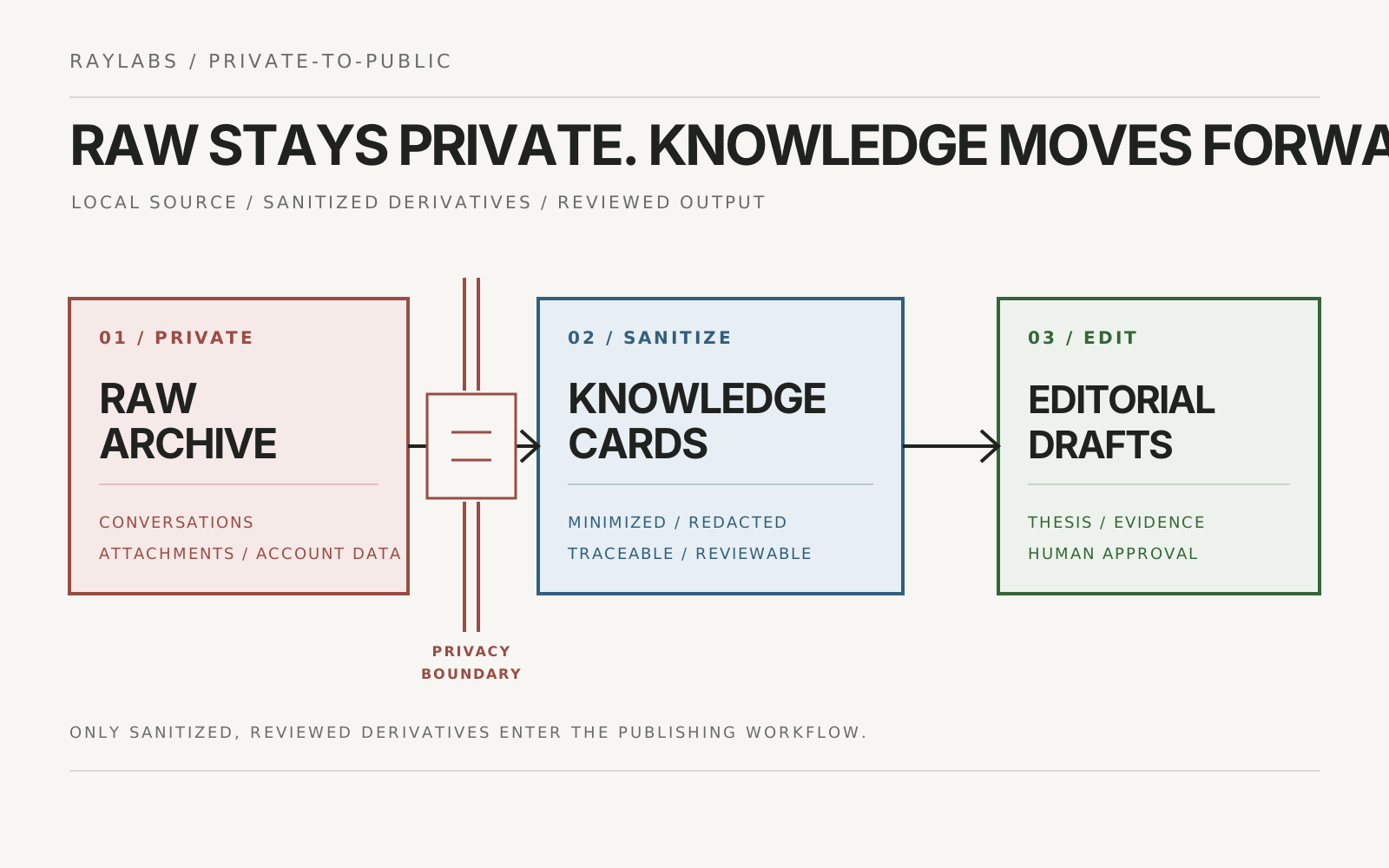
A ChatGPT export is not a knowledge base. It is a mixed archive that can include conversations, attachments, and account data.
The goal is to turn useful conversations into reusable technical notes without placing raw source material in a repository or an unreviewed publishing workflow.
The design question is not only how to import a ChatGPT history. It is how to extract durable technical knowledge without turning private source material into a permanent security risk.
The proposed answer is a local-first, three-layer workflow: keep the raw export private, convert selected conversations into sanitized knowledge cards, and write drafts only from those cards.
Why a ChatGPT Export Is Not a Knowledge Base
OpenAI’s export documentation describes chat history and other account data. Export structure can vary, so any local file inventory is a private, time-bound measurement rather than a universal schema.
An export can include conversation history, a human-readable browsing copy, attached or generated files, account-level data, and both compressed and extracted copies. Inventory counts are intentionally omitted here. If any aggregate is published later, it should identify its source scope, timestamp, deduplication method, and retention boundary.
That structure is useful as a personal data export. It is not automatically a clean technical corpus.
Copying the entire directory into Git would create several risks. GitHub documents how sensitive data can persist across repository history and distributed copies:
- Sensitive data is difficult to remove completely after it enters repository history.
- Copies can remain in clones, forks, cached references, backups, and pull requests.
- Conversation text can contain credentials even when the topic is harmless.
- Screenshots can expose information that a text-only scanner misses.
- Duplicate attachments increase storage without adding knowledge.
A gitignore rule helps prevent an untracked file from being committed, but it is not the primary privacy boundary. The safer design keeps raw data outside the repository directory entirely.
In this design, the archive remains a private source. It does not become the knowledge base itself.
A Three-Layer ChatGPT Archive Workflow
The design separates the system into three layers:
Private Raw Archive
        ↓
Sanitized Technical Knowledge
        ↓
Editorial Backlog and Drafts
Each layer has a different purpose and trust boundary.
Layer 1: Private Raw Archive
The proposed boundary keeps the raw export unchanged in encrypted local storage. Its actual storage state must be confirmed privately before publication.
The proposed boundary also excludes it from the RayLabs repository and publishing automation; source material is not treated as safe merely because it came from the same account.
This layer exists to preserve the original source and allow a selected item to be traced during private review. Most publishing workflows should never need to read it after the initial local processing pass.
Layer 2: Sanitized Technical Knowledge
Useful conversations become small knowledge cards instead of retained transcripts:
Topic
Problem
Important context
Decision
Alternative approaches
Trade-offs
Reusable example
Open questions
Privacy notes
A synthetic example of a knowledge card might look like this:
Topic: Long-term memory for an AI coding agent

Problem:
Active context becomes noisy and expensive as history grows.

Decision:
Separate working memory from the long-term archive.

Approach:
- Keep current task state in active context.
- Store durable decisions as small knowledge units.
- Retrieve historical information only when relevant.

Trade-off:
Retrieval can select irrelevant or misleading context.
The card preserves the engineering lesson while removing conversational noise.
Layer 3: Editorial Backlog and Drafts
Knowledge cards are grouped into themes before an article is written.
Several cards about context windows, retrieval, memory, and automation may support one editorial topic. A card does not automatically become an article, and one conversation does not need to support an entire article.
The editorial layer records:
- proposed title;
- intended audience;
- central thesis;
- supporting technical claims;
- concrete examples;
- known uncertainties;
- privacy and verification notes;
- draft status.
This prevents a writing stage from turning a random conversation into a confident but shallow article.
What Counts as Useful Technical Knowledge?
A practical technical scope includes:
- AI agents, LLMs, prompting, retrieval, memory, and orchestration;
- software architecture, backend systems, APIs, and databases;
- Android, Kotlin, Compose, and multiplatform development;
- deployment, CI/CD, cloud infrastructure, and monitoring;
- security, authentication, privacy, and secrets management;
- testing, debugging, performance, and engineering workflow.
A conversation qualifies when it contains a reusable problem, decision, method, or lesson.
A technical word in a title is not enough. Automated selection therefore produces a shortlist, not final approval.
The local selector should produce a shortlist, not an automatic publication decision. Keep its counts, scope, and classification rules in private evidence; disclose them only after accuracy and the privacy trade-off are approved. Classification narrows review instead of replacing it.
How to Sanitize a ChatGPT Export
Obvious identifiers include:
- names;
- email addresses;
- phone numbers;
- physical addresses;
- IP addresses;
- account and payment identifiers.
Technical conversations introduce another sensitive category:
- API keys and tokens;
- authenticated URLs;
- private repository names;
- branch and pull-request identifiers;
- absolute filesystem paths;
- internal hostnames;
- customer and project names;
- code copied from a private system.
Typed placeholders preserve the shape of an example. The mapping below is entirely synthetic and contains no source value from the archive:
ILLUSTRATIVE PLACEHOLDER MAPPING

[SOURCE_LOCAL_PATH]
→ [LOCAL_PROJECT_PATH]

[SOURCE_INTERNAL_HOST]
→ [INTERNAL_SERVICE]

[SOURCE_CLIENT_NAME]
→ [CLIENT_PROJECT]
Any replacement map must remain local and outside Git.
Sanitization also applies to logs. Security logs can themselves expose tokens, personal data, file paths, internal hostnames, or commercially sensitive information. A workflow should emit bounded status and evidence, not raw conversations or raw tool output.
Why Attachments Stay Out by Default
Attachment counts are intentionally omitted. If they are inventoried privately, record whether compressed, extracted, and duplicate assets are included. No attachment enters the technical corpus automatically.
Some may be useful, but attachments have a higher review cost than plain conversation text. A screenshot can contain a notification, email address, account balance, repository URL, or browser tab unrelated to the technical point. A generic-looking CSV can contain customer data.
The default rule is:
No attachment enters the technical corpus automatically.
If an image is necessary, it is reviewed separately, recreated or cropped when appropriate, and checked again after editing. Recreating an explanatory diagram is often safer and clearer than redacting a screenshot.
Separate the Worker from the Reviewer
The stage that creates an artifact should not be its only approval control.
Selector
  ↓
Sanitizer
  ↓
Knowledge Extractor
  ↓
Draft Writer
  ↓
Privacy and Technical Review
These do not need to be five expensive autonomous agents. They can be bounded stages in one local workflow:
- The selector finds technical candidates.
- The sanitizer removes or replaces sensitive material.
- The extractor converts dialogue into structured knowledge.
- The writer combines reviewed knowledge into an article.
- The reviewer checks privacy, traceability, and technical accuracy.
Every source item, attachment, web page, and model result should be treated as untrusted data. The workflow must enforce that instruction-like content inside an archive cannot alter its authority, instructions, permissions, or approval rules.
For a related discussion of agent orchestration and worker boundaries, see Should Your AI Coding Agent Run on a VPS or Your Mac?.
Keep Raw ChatGPT Data Out of Git
The proposed repository contains derived artifacts only. The following layout is illustrative rather than a real local path:
ILLUSTRATIVE REPOSITORY LAYOUT

sanitized-knowledge/
├── knowledge/
│   ├── ai-agents/
│   ├── architecture/
│   ├── android-kotlin/
│   ├── devops-cloud/
│   ├── security-privacy/
│   └── testing-performance/
├── drafts/
└── policies/
    └── sanitization.md
In the proposed boundary, the raw export, local replacement map, and unreviewed material would live outside that repository.
A Safe Workflow for New Conversations
The historical export is a migration problem. New conversations need a smaller ongoing workflow:
New technical discussion
        ↓
Create sanitized knowledge card
        ↓
Add it to the editorial backlog
        ↓
Cluster it with related cards
        ↓
Create or improve one draft
The intended publishing process reads only the sanitized backlog. It does not repeatedly scan the private archive.
What the Workflow Preserves
Archival completeness and editorial usefulness are different goals.
A complete archive preserves everything. A useful knowledge base preserves only what remains valuable after context, repetition, and private details are removed.
Privacy work must happen before content generation. Redacting the final article is too late if raw conversations have already entered repositories, prompts, logs, or external services.
AI conversation management is not mainly a storage problem. It is a transformation problem:
Conversation
→ Evidence
→ Knowledge
→ Editorial argument
→ Reviewed draft
The workflow preserves decisions and lessons without carrying every private source word into the publishing boundary.
The Trade-off
The initial ambition was a system that could read a large conversation history and automatically produce RayLabs articles.
The proposed architecture is more deliberate. The raw archive stays private, technical knowledge is extracted locally, and drafts are created only from sanitized, reviewable material.
That adds a step before writing. It also creates a workflow that can be evaluated before it receives another batch of conversations.
Continue Exploring
You Might Also Like

Structuring Reusable Templates and Documentation
Learn how to structure reproducible templates and README files for cross-functional developer tools and multi-platform projects.
Writing Technical README Instructions for Resilient Android Projects
A comprehensive guide on creating technical README instructions that promote resiliency, ease of setup, and long-term maintainability for Android software projects.

Mastering List to String Conversion in Mobile Development
An in-depth guide on handling list to string conversion, managing Android lifecycles, and avoiding memory leaks during state transformation.